
PRESENTED BY HOLY CLERGY
Nun Habit vs. Monastic
Habit: What’s the
Real Difference?
A clear guide to what actually separates a nun’s habit from a monastic habit — by design, symbolism, and the religious order behind each one.
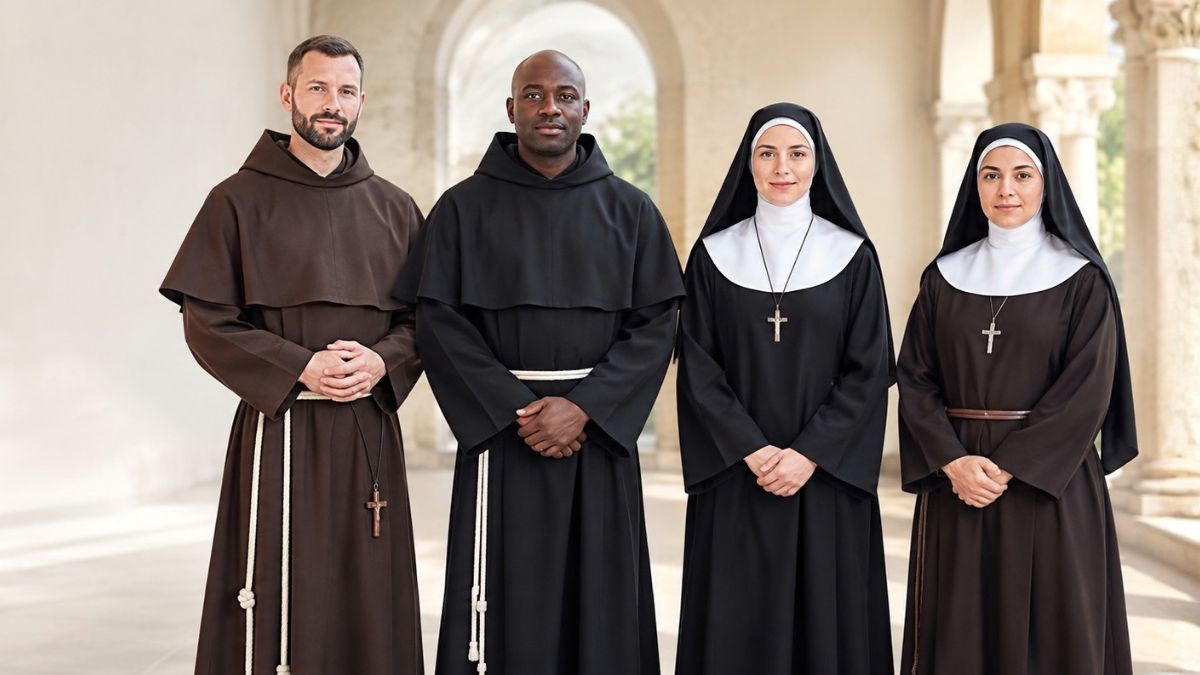
A nun’s habit is worn by women religious and is identified mainly by its veil, often with a wimple or coif. A monastic habit is worn by men religious — monks and friars — and is identified mainly by its hood or cowl instead of a veil. Beyond that, both garments are shaped by order, not gender alone: color, scapular style, and cincture all depend on whether the wearer belongs to a Franciscan, Benedictine, Dominican, Carmelite, or other community.
At first glance, a nun’s habit and a monk’s habit can look like variations on the same idea: a long tunic, a rope or cloth belt, simple fabric, and very little ornamentation. And in spirit, they are related — both grew out of the same monastic tradition of dressing for humility rather than fashion. But the two garments are built differently, mean slightly different things, and are worn by people living very different forms of religious life. If you’re shopping for either one, or you’re just curious about what you’re looking at, here’s a clear, complete breakdown. For a closer look at how the habit fits into daily religious life, see a day in the life of a nun.
A Shared Root: Where the Habit Tradition Began
Both garments trace back to the same source: the plain, practical clothing worn by the earliest Christian monastics in the third and fourth centuries. Men and women who withdrew from ordinary life to devote themselves to prayer adopted simple, undyed tunics — not as a fashion statement, but as a deliberate rejection of one. Clothing that didn’t draw attention to wealth, status, or individuality freed the wearer to focus entirely on community and contemplation.
As religious orders formed over the following centuries — Benedictines in the 6th century, Franciscans and Dominicans in the 13th, Carmelites tracing back even earlier — each community developed its own variation on that original simplicity. The differences you see today in color, cut, and accessories aren’t arbitrary style choices. They’re the accumulated identity of a specific order, refined and preserved over hundreds of years. That’s why a habit still communicates so much at a glance: it’s a visual record of which rule of life the wearer follows.
What a Nun’s Habit Actually Is
A nun’s habit is the traditional dress of a woman living in vowed religious life — a nun or religious sister. Structurally, it usually includes:
- A tunic or habit dress — typically full-length, long-sleeved, and made from a plain, durable fabric
- A scapular — a long panel of cloth worn over the shoulders, front and back, with spiritual significance tied to the order’s rule of life
- A veil — covering the hair, often paired with a wimple or a simple coif
- A cincture or belt — worn at the waist, sometimes with a rosary attached
Color and cut vary significantly by community. Benedictine sisters often wear black, Dominican sisters traditionally wear white with a black veil, and other congregations use gray, brown, or even blue, depending on their founding tradition. Some communities have simplified their habits over the decades; others have kept the traditional design largely unchanged.
Within formation, the habit itself can also mark a stage of religious life. A postulant may wear simpler, unveiled attire; a novice often receives a white veil at the start of the novitiate; and a black veil is frequently given at first or final profession, depending on the order’s own customs. This is one of the most overlooked details of the habit — it isn’t static. It tells you not just which order someone belongs to, but often where they are on their path within it.
What a Monastic Habit Actually Is
A monastic habit is worn by men in religious orders — monks and friars — living under a communal rule of life. The core pieces are similar in spirit but different in form:
- A tunic — long, loose-fitting, designed for ease of movement during manual work, prayer, and community life
- A hood or cowl — often pointed, and in many orders worn up during periods of silence or prayer
- A cincture — usually a rope belt, sometimes knotted (Franciscan habits are traditionally tied with three knots, representing poverty, chastity, and obedience)
- A scapular — similar in concept to the women’s version, worn over the tunic
Where nun habits are distinguished mainly by veil style and color, monastic habits are distinguished mainly by order: Franciscan habits tend toward simple, unadorned brown or gray; Benedictine habits are traditionally black; Dominican habits are white with a black cappa; Carmelite habits are brown, often with a lighter scapular.
It’s also worth noting that “monk” and “friar” aren’t interchangeable, even though both wear a monastic-style habit. A monk (Benedictine, Cistercian) generally lives a stable, cloistered life within one monastery. A friar (Franciscan, Dominican, Carmelite) belongs to a mendicant order, traditionally moving between towns to preach, teach, or serve rather than remaining enclosed. Their habits share a common structure but grew out of two different ways of living religious life.
The Core Differences at a Glance
| Nun’s Habit | Monastic Habit | |
|---|---|---|
| Worn by | Women religious (nuns, sisters) | Men religious (monks, friars) |
| Head covering | Veil, often with wimple or coif | Hood or cowl (no veil) |
| Typical belt | Cloth cincture, sometimes with rosary | Rope cincture, often knotted |
| Key identifier | Veil style and color | Order-specific color and hood shape |
| Common colors | Black, white, gray, brown, occasionally blue | Black, brown, white, gray |
| Marks formation stage | Yes — veil color often changes at profession | Less commonly — habit is usually consistent from novitiate onward |
The biggest visual distinction isn’t the tunic — it’s the head covering. A veil signals a nun’s habit; a hood or cowl signals a monastic habit. Everything else is shaped by which specific order the person belongs to, which is why “what does a habit look like” doesn’t have one single answer — it depends on the community.
The Symbolism Behind Each Piece
| Piece | Symbolic meaning |
|---|---|
| Tunic | Simplicity and detachment from personal vanity or fashion |
| Scapular | Originally a work apron; came to represent taking up the “yoke” of religious life |
| Cincture (knotted) | The three knots on a Franciscan cincture stand for poverty, chastity, and obedience |
| Veil | Consecration and modesty; in some traditions, echoes a bride’s veil |
| Wimple / Coif | Modesty in framing the face, away from focus on appearance |
| Hood / Cowl | Withdrawal into prayer — many monks raise the hood during contemplative prayer |
This is also where a well-made habit matters practically, not just symbolically. A cincture meant to be knotted needs rope of the right weight and length to hold a knot properly; a veil needs fabric with enough structure to hold its shape through a full day of movement. Garments built for costume use rarely account for this.
Habit by Order: A Side-by-Side Comparison
| Order | Typical Color | Distinguishing Feature | Way of Life |
|---|---|---|---|
| Benedictine | Black | Wide sleeves, scapular, hood or veil | Contemplative, “ora et labora” |
| Franciscan | Brown or gray | Pointed hood, knotted cincture | Radical simplicity, itinerant ministry |
| Dominican | White, black cappa/veil | Rosary at the cincture | Study, preaching, teaching |
| Carmelite | Brown, light scapular | Simple, contemplative styling | Prayer, contemplation |
| Cistercian | White/undyed, black scapular | Close variant of Benedictine habit | Strict contemplative, manual labor |
If your own community’s tradition isn’t listed here or differs in some detail, that’s normal — many congregations have their own refinements on these base traditions. The table above reflects the most commonly recognized conventions, not a universal rule.
Why the Habit Still Matters Today
Both garments exist for the same underlying reason: to visibly set aside personal identity and fashion in favor of a shared, communal one. Wearing a habit is a daily, physical reminder of vows taken — poverty, chastity, obedience — and it signals belonging to a specific order with its own history and charism.
“The habit does not make the monk,” the old saying goes — but for those who wear one daily, it still shapes how the day is lived.
At the same time, some religious communities today wear simplified or modernized versions of these garments for daily tasks, reserving the full traditional habit for liturgy, ceremonies, or the profession of vows. Both approaches are common, and neither is “more correct” than the other — it depends on the community’s own rule and tradition.
A Common Misconception Worth Clearing Up
Search for “nun habit” or “monk habit” online and most of what comes up is costume and cosplay material — Halloween outfits, Renaissance-faire robes, or LARP gear. That’s a real source of confusion, and it’s worth naming directly: a devotional habit and a costume habit are not the same product, even when they look similar in a thumbnail photo.
A garment made for actual religious use is built to be worn for hours at a time, day after day, through kneeling, walking, and manual work — real fabric weight, reinforced seams, a properly weighted cincture, a veil or hood that holds its shape. If you’re outfitting yourself, a novice, or your community for genuine religious life, sourcing from a supplier that works specifically with religious and clergy apparel makes a meaningful difference in how the garment holds up.
Choosing the Right Habit
- Know your order’s tradition first. Color, scapular style, and veil or hood shape should match your community’s established custom.
- Prioritize breathable fabric in warmer climates. Poly-cotton and lightweight cotton blends outperform heavier wool blends for daily wear.
- Get accurate measurements before ordering. A habit needs to allow free movement for kneeling, walking, and daily tasks.
- Custom sizing is worth it for daily-wear pieces. A custom measurement keeps the habit sitting correctly at the waist and shoulder for years.
- Ask before assuming a detail is standard. Cincture length, hood depth, and scapular width can vary even within one order — confirm before ordering.
Explore the Full Collections
Whether you’re outfitting a novice, replacing a well-worn habit, or sourcing habits for an entire community, Holy Clergy carries both traditions with order-specific detail.
Nun Habits
Traditional and modern styles in black, white, and gray — veil and scapular sets, sized extra small through plus size, with custom measurements available.
Shop Nun HabitsMonks Habits
Franciscan, Benedictine, Dominican, and Carmelite styles in poly-cotton and raw cotton, with custom sizing for individuals and bulk community orders.
Shop Monks HabitsFrequently Asked Questions
Is a monk’s habit the same as a friar’s habit?
Not exactly. Monks generally live a cloistered, contemplative life within one monastery, while friars — Franciscans and Dominicans, for example — live and minister within communities. Their habits often look similar in structure, but the terms describe different forms of religious life.
Can a habit be custom-made to match a specific order’s tradition?
Yes. Because color, scapular design, and veil or hood shape vary so much by order, custom-made habits are common — especially for communities that want to match an established tradition precisely rather than use a generic design.
Do all nuns and monks still wear traditional habits daily?
No. Some communities wear the traditional habit daily; others reserve it for liturgy, ceremonies, or the profession of vows and use simplified attire for daily work. Both practices are common today and reflect each community’s own rule of life.
Is it appropriate to buy a habit if I’m not a member of a religious order?
Habits are meaningful religious garments, and reputable suppliers generally expect them to be treated that way. If you’re purchasing for a devotional, educational, or ceremonial reason outside of formal religious life, it’s worth reaching out to the supplier directly to discuss the right product.
How much does a nun or monk habit typically cost?
Pricing varies by fabric, customization, and how many pieces are included. Standard, ready-made habits generally fall in a mid-range price bracket, while fully custom-made pieces with tailored measurements and specific order detailing cost more, reflecting the added construction time.




Recent Comments