
Advent 2026 dates, how long the season lasts, what the first Sunday of Advent means, and how to light the first candle of hope.
In Short
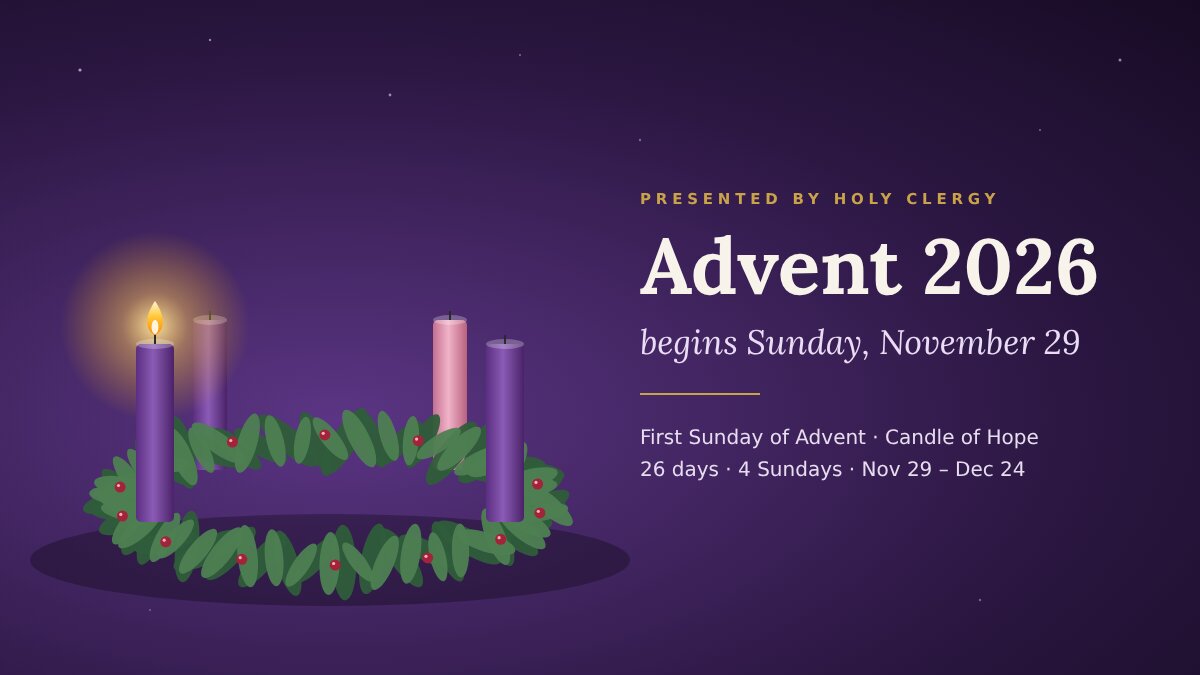
Advent 2026 begins on Sunday, November 29, 2026, the First Sunday of Advent. It ends on Thursday, December 24 (Christmas Eve), so the season lasts 26 days and includes four Sundays: November 29, December 6, December 13 and December 20. The first Sunday’s theme is hope, marked by lighting the first purple candle on the Advent wreath, often called the Prophecy Candle.
Every year around Thanksgiving, the same question pops up in parish offices, family group chats and search bars: when does Advent start? It feels like it should land on a fixed date the way Christmas does. It doesn’t, and that small detail trips up a lot of people, from families planning an Advent calendar to pastors ordering purple stoles.
This guide answers it plainly. You’ll find the Advent 2026 dates, how many days are in Advent this year, an easy way to check what day of Advent it is today, and the meaning behind the first Sunday of Advent: its readings, its candle, its prayers and its colour.
When Is Advent 2026? Key Dates at a Glance
Advent begins in 2026 on Sunday, November 29. That is the first day of Advent and the first Sunday of Advent at the same time, because the season always opens on a Sunday. It is also the start of a new liturgical year, so the church calendar quietly “resets” a full month before January 1.
Here are the Advent 2026 dates most people need:
| Day | Date | What it marks |
|---|---|---|
| First Sunday of Advent | Sunday, November 29, 2026 | Advent begins; candle of Hope |
| Second Sunday of Advent | Sunday, December 6, 2026 | Candle of Peace (or Faith) |
| Third Sunday of Advent (Gaudete) | Sunday, December 13, 2026 | Rose candle of Joy |
| Fourth Sunday of Advent | Sunday, December 20, 2026 | Candle of Love; the Sunday before Christmas |
| Last day of Advent | Thursday, December 24, 2026 | Advent ends at the Christmas Eve vigil |
| Christmas Day | Friday, December 25, 2026 | Christmas season begins |

The date is the same for Catholic, Anglican, Episcopal, Lutheran and Methodist churches, and the same in the USA, the UK and the rest of the Western church. In German-speaking countries you will see it called Erster Advent (1. Advent 2026: 29. November), and in Sweden första advent, but it is the same Sunday.
One common mix-up: some calendars and search results mention a first Sunday of Advent on November 30. That was 2025. In 2026 it falls one day earlier, on November 29.
Note on the Orthodox calendar: Eastern Orthodox Christians keep a longer, 40-day Nativity Fast that begins on November 15, so their preparation season does not line up with Western Advent.
How Long Is Advent? Days, Weeks and Sundays
Advent 2026 is 26 days long, running from November 29 through December 24. That number changes every year, which is why “how many days is Advent” gets asked so often.
The rule is simple once you see it. Advent always has four Sundays, and the fourth Sunday is always the last Sunday before Christmas. What moves is the weekday Christmas falls on:
- If Christmas is on a Monday, the fourth week of Advent is just one day (Sunday, December 24), and Advent is only 22 days.
- If Christmas is on a Sunday, the fourth week runs a full seven days, and Advent stretches to 28 days.
- Every other year lands somewhere in between.
In 2026 Christmas falls on a Friday, so the fourth week is five days long (December 20 to 24). That gives you three full weeks plus a short fourth one.
So, how many weeks are in Advent? People say four weeks of Advent because there are four Sundays and four candles. In practice, the fourth “week” is usually shorter than seven days. For 2026, the quick answers are:
- Days in Advent 2026: 26
- Sundays in Advent: 4
- Weeks of Advent: 4 (the last one partial)
- Earliest possible start: November 27
- Latest possible start: December 3
Wondering how many days until Advent? From October 1 there are 59 days to go, and from November 1 just 28. Thanksgiving in the US falls on November 26, so Advent begins the Sunday right after it.
What Day of Advent Is It Today?
To find what day of Advent it is today, count from November 29 as Day 1. In December there is an even quicker trick: add 2 to the date. December 1 is Day 3, December 10 is Day 12, and Christmas Eve is Day 26.
Use this table to see which week of Advent you are in:
| Week of Advent | Dates (2026) | Advent days | Sunday theme |
|---|---|---|---|
| Week 1 | Nov 29 – Dec 5 | Days 1–7 | Hope |
| Week 2 | Dec 6 – Dec 12 | Days 8–14 | Peace |
| Week 3 | Dec 13 – Dec 19 | Days 15–21 | Joy |
| Week 4 | Dec 20 – Dec 24 | Days 22–26 | Love |
Are we in Advent right now? If today’s date falls between November 29 and December 24, 2026, yes. If it is before November 29, the church is still in Ordinary Time, finishing the year with the Solemnity of Christ the King on November 22. From the evening of December 24, Advent is over and Christmastide has begun.
One thing to keep in mind: the day of Advent and the door on your Advent calendar are usually not the same number. Most calendars start on December 1, while the season itself started on November 29. More on that below.
How the First Sunday of Advent Is Determined
The first Sunday of Advent is the fourth Sunday before Christmas Day. Another way churches have long put it: Advent begins on the Sunday closest to November 30, the feast of St. Andrew the Apostle. Both rules give the same answer every year.
That is why the first Sunday of Advent can never fall earlier than November 27 or later than December 3. It is also why it is never the first Sunday of November, a mix-up that shows up surprisingly often online.
Here is when the first Sunday of Advent fell in recent years, and when it falls next. The “Year” column is the Sunday reading cycle used in Catholic and Revised Common Lectionary churches.
| Year | First Sunday of Advent | Sunday reading cycle |
|---|---|---|
| 2027 | November 28 | Year C |
| 2026 | November 29 | Year B |
| 2025 | November 30 | Year A |
| 2024 | December 1 | Year C |
| 2023 | December 3 | Year B |
| 2022 | November 27 | Year A |
| 2021 | November 28 | Year C |
| 2020 | November 29 | Year B |
| 2019 | December 1 | Year A |
| 2018 | December 2 | Year C |
| 2017 | December 3 | Year B |
| 2016 | November 27 | Year A |
| 2015 | November 29 | Year C |
| 2014 | November 30 | Year B |
The dates are identical in the UK, the USA and across the Catholic and Protestant churches of the West, because they all follow the same Christmas date and the same counting rule.
What Is the First Sunday of Advent? The Theme of Hope
The first Sunday of Advent is the day the Church begins a new year of worship and starts preparing for Christmas. Its theme is hope, and its message can be summed up in one word from the Gospel: watch.
The word Advent comes from the Latin adventus, meaning “coming” or “arrival.” The season looks in two directions at once. It looks back to the first coming of Christ at Bethlehem, and it looks forward to his promised return at the end of time. The first Sunday leans hard toward that second direction. The readings talk about staying awake, keeping your lamp lit, and being ready for a master who could come home at any hour.
That is where the hope comes from. Not a vague optimism, but the confidence that God keeps his promises. The people of Israel waited centuries for the Messiah the prophets foretold. Christians now wait, with the same trust, for Christ to come again.

What is the first Sunday of Advent called? It goes by several names:
- Advent Sunday, the common name in the Church of England and much of the English-speaking world.
- Hope Sunday, after the theme of the first candle.
- Ad Te Levavi Sunday, from the opening words of the traditional Latin entrance chant, taken from Psalm 25: “Unto thee, O Lord, do I lift up my soul.”
Why is the first Sunday of Advent important? Because it sets the tone for everything that follows. It turns a busy, commercial month into a season of waiting and preparing. Many parishes begin new habits that day, such as a daily Advent devotional, an Advent wreath at home, or a weekly confession before Christmas.
The First Advent Candle: Which One Is Lit First?
On the first Sunday of Advent, you light one purple candle. It is the candle of hope, and it is often called the Prophecy Candle or the Prophet’s Candle, in honour of Isaiah and the other prophets who foretold the coming of the Messiah.
A traditional Advent wreath is a circle of evergreens holding four candles: three purple and one rose (pink). The circle stands for God’s endless love, and the evergreens for life that does not fade in winter. Many families and churches add a white Christ Candle in the centre, lit on Christmas Eve or Christmas Day.
The usual lighting order looks like this:
| Sunday | Candle | Common name | Theme |
|---|---|---|---|
| 1st Sunday | Purple | Prophecy Candle | Hope |
| 2nd Sunday | Purple | Bethlehem Candle | Peace (or Faith) |
| 3rd Sunday | Rose | Shepherds’ Candle | Joy |
| 4th Sunday | Purple | Angels’ Candle | Love |
| Christmas | White | Christ Candle | Christ’s birth |

The themes are not fixed by any single rule, so you will see Peace and Love swapped in some churches, or the second candle called Faith. The one constant is that the first candle is hope.
What does the first candle of Advent symbolize? Light breaking into darkness. One small flame on a dark December evening is a simple picture of what the prophets promised. As Isaiah 9:2 puts it in the King James Version, “The people that walked in darkness have seen a great light.” Each week another candle is added, and the wreath grows brighter as Christmas draws near.
Some Lutheran, Methodist and Anglican churches use blue candles instead of purple. Blue points to hope and expectation and helps set Advent apart from the more penitential purple of Lent. Either colour is correct; it simply depends on your tradition.
Readings for the First Sunday of Advent 2026
The first Sunday of Advent 2026 opens Year B of the Sunday lectionary, the year that reads mainly from the Gospel of Mark. Catholic Mass and churches using the Revised Common Lectionary (Episcopal, Lutheran, Methodist, Presbyterian and others) share the same Gospel passage, with slightly different verse ranges.
| Reading | Catholic Mass (Year B) | Revised Common Lectionary (Year B) |
|---|---|---|
| First reading | Isaiah 63:16b–17, 19b; 64:2–7 | Isaiah 64:1–9 |
| Psalm | Psalm 80:2–3, 15–16, 18–19 | Psalm 80:1–7, 17–19 |
| Second reading | 1 Corinthians 1:3–9 | 1 Corinthians 1:3–9 |
| Gospel | Mark 13:33–37 | Mark 13:24–37 |
What the readings say:
- Isaiah is a cry from people who feel far from God. They ask him to tear open the heavens and come down, and they confess, “we are the clay, and thou our potter.” It is hope spoken honestly, from a place of need.
- Psalm 80 repeats one plea again and again: turn us back, Lord, and let your face shine on us so we may be saved.
- St. Paul reminds the Corinthians that they lack no spiritual gift while they wait for Christ to be revealed, and that God is faithful.
- The Gospel of Mark is Jesus’ short parable of a man who leaves home and tells the doorkeeper to stay on watch. Nobody knows when the master will return, so the instruction to all is the same: stay awake.
If you are planning for other years, the Gospel for the first Sunday of Advent rotates on a three-year cycle: Year A reads Matthew 24:37–44 (used in 2025), Year B reads Mark 13 (2026), and Year C reads Luke 21:25–28, 34–36 (2027).
Prayer, Hymns and Ways to Celebrate the First Sunday of Advent
A prayer for the first Sunday of Advent
This short prayer works for lighting the first candle at home, opening a small group, or as a family grace on Advent Sunday:
Lord God, we light this first candle as a sign of hope. When the world feels dark, remind us that your light is coming. Wake us up from busyness and distraction, and keep our hearts watchful for your Son, Jesus Christ. Make this Advent a season of honest waiting and quiet trust. Amen.
Catholic parishes will pray the Collect of the First Sunday of Advent from the Roman Missal at Mass, which asks God for the resolve to run out and meet Christ with good works when he comes. Episcopal and Anglican churches use the well-known Advent collect from the Book of Common Prayer, which asks for grace to “cast away the works of darkness, and put upon us the armour of light.”
Hymns for the first Sunday of Advent
Traditionally, Christmas carols wait until Christmas. Advent has its own beautiful songs of longing and expectation. These are the hymns most often sung on the first Sunday of Advent:
- O Come, O Come, Emmanuel, the best-known Advent hymn, based on ancient Latin antiphons
- Come, Thou Long-Expected Jesus, by Charles Wesley
- Creator of the Stars of Night, an old Latin hymn often sung at evening prayer
- Lo, He Comes with Clouds Descending, which fits the first Sunday’s focus on Christ’s return
- Wake, Awake, for Night Is Flying, a Lutheran chorale built on the parable of the ten bridesmaids
- On Jordan’s Bank the Baptist’s Cry, often saved for the second Sunday but sung in many places on the first
How to celebrate the first Sunday of Advent
You do not need much to mark the day well. A few simple ideas:
- Set up an Advent wreath and light the first candle at dinner, with a short Bible reading and prayer.
- Pick a daily Advent devotional or reading plan and start it that evening.
- Begin a Jesse Tree, adding one ornament each day that tells a story from Scripture leading to Jesus.
- Choose one act of preparation, such as going to confession, giving to a food pantry, or setting aside screen time for prayer.
- Talk about hope with children: what are we waiting for, and why is waiting worth it?
Scripture verses about hope for Advent
For a weekly devotional or a sermon on the first Sunday of Advent, these passages pair well with the hope theme: Isaiah 9:2, Isaiah 40:31, Jeremiah 33:14–16, Lamentations 3:22–23, Romans 15:13, and Titus 2:13.
Advent Calendars: How Many Days Are There?
Most Advent calendars have 24 days, one door for each day from December 1 to December 24. Some include a 25th door for Christmas Day. That is the standard answer to “how many days are in an Advent calendar,” and it is why the calendar rarely matches the real length of the season.
The liturgical season, as we saw above, starts on a different date each year. In 2026 it begins on November 29, so it is 26 days long. A handful of church-made calendars, especially Catholic and Lutheran ones, follow the actual season and start on the first Sunday of Advent instead.
When should you start your Advent calendar in 2026?
- A standard 24-door calendar: open the first door on December 1.
- A liturgical calendar that follows the season: start on Sunday, November 29.
- A countdown-style calendar (doors numbered from 24 or 25 down to 1): start on December 1 with the highest number, and open “1” on Christmas Eve or Christmas Day.
The idea is older than the cardboard version. Families in 19th-century Germany marked off the days of December with chalk lines on a door or lit a candle each day. Printed Advent calendars appeared in Germany in the early 1900s, and the little paper doors became popular around the world after that.
If you want a faith-centred calendar rather than a chocolate one, look for one with a Scripture verse or short prayer behind each door. Catholic bookshops, Christian bookstores and many parish gift shops stock them from early November.
A Short History of Advent
Advent was first celebrated as a season of preparation in the late 300s and 400s, in Spain and Gaul (modern France). At first it looked a lot like Lent. Christians fasted and prayed for several weeks, partly to prepare new believers for baptism at Epiphany.
A few milestones explain how we got to today’s four Sundays:
- 4th–5th century: Church councils in Spain and Gaul encourage the faithful to attend church daily in the weeks before Epiphany. In Tours, Bishop Perpetuus sets a fast beginning on St. Martin’s Day, November 11, which became known as “St. Martin’s Lent.”
- 6th century: In Rome, the season is tied more closely to Christmas. Under Pope Gregory the Great, Advent settles into the four-Sunday pattern the Western Church still keeps.
- Middle Ages: Advent gains its double focus on Christ’s birth and his second coming, which is why the first Sunday’s readings speak of the end of time.
- 1839: Lutheran pastor Johann Hinrich Wichern is credited with the first Advent wreath, a wooden cartwheel with candles he lit with the children in his care in Hamburg. It was later simplified to the four-candle evergreen wreath we know.
Not every tradition uses four weeks. The Ambrosian Rite in Milan keeps a six-week Advent, and the Eastern Orthodox Nativity Fast runs for 40 days.
What Clergy Wear During Advent
The liturgical colour for the first Sunday of Advent is violet (purple). It is the colour of royalty and of preparation, a reminder that the King is coming and that hearts need getting ready. Many Lutheran, Methodist and Anglican churches use blue instead, the colour of hope and expectation.
Here is how the colours change through the season:
- First, second and fourth Sundays: violet or blue
- Third Sunday (Gaudete Sunday): rose, a lighter shade that signals joy because Christmas is near
- Christmas Eve and Christmas Day: white or gold

For clergy, that usually means a violet stole and chasuble at Mass, or a violet or blue stole over a pulpit robe for Protestant pastors. Deacons wear the matching violet dalmatic or stole, and altar servers keep their cassocks and surplices fresh for the busy weeks ahead.
What colour should you wear on the first Sunday of Advent? There is no rule for the congregation. Some people like to wear purple or deep blue to echo the season, but your ordinary Sunday clothes are perfectly fine.
If your parish or church is getting ready for Advent, now is the time to check your vestments. At Holy Clergy, our collections cover everything the season calls for:
- Clergy Stoles — violet, blue, rose and white stoles for every Sunday of Advent and Christmas
- Clergy Robes for Men and Clergy Robes for Women — pulpit and preaching robes for Advent services
- Clergy Cassocks — the foundation garment under liturgical vestments
- Vestments — full liturgical sets for celebrants and ministers
- Clergy Shirts — everyday clerical wear for hospital visits, carol services and parish events
- Altar Server Cassocks and Surplices — for servers at Advent Masses and Christmas Eve
Orders placed in October and early November give the most breathing room before November 29, especially for custom sizes or fabrics.
Continue Reading
Frequently Asked Questions
When does Advent start in 2026?
Advent starts on Sunday, November 29, 2026. This is the First Sunday of Advent and the first day of the new liturgical year for Catholic and most Protestant churches.
When does Advent end in 2026?
Advent ends on Thursday, December 24, 2026. The season closes with the evening celebrations of Christmas Eve, when the Christmas season begins.
How many days are in Advent 2026?
There are 26 days in Advent 2026, counting from November 29 through December 24. The length changes every year, from as few as 22 days to as many as 28.
How many Sundays are in Advent?
There are always four Sundays in Advent. In 2026 they fall on November 29, December 6, December 13 and December 20.
Is the first Sunday of Advent always about hope?
In most churches, yes. The first candle is the candle of hope, sometimes called the Prophecy Candle. A few traditions arrange the themes differently, but hope on the first Sunday is the most widely used.
Which Advent candle is lit first?
A purple candle is lit first. The rose candle is saved for the third Sunday, Gaudete Sunday, and the white Christ Candle in the centre is lit on Christmas.
What colour is the first Sunday of Advent?
Violet (purple) is the liturgical colour, worn by the priest or pastor and used on the altar. Some Protestant churches use blue instead.
Is Catholic Advent the same date as Protestant Advent?
Yes. Catholic, Anglican, Episcopal, Lutheran and Methodist churches all begin Advent on the same Sunday, November 29, in 2026.
Why don’t Advent calendars match the start of Advent?
Most Advent calendars simply count December 1 to 24, so they always have 24 doors. The church season begins on the fourth Sunday before Christmas, which can fall anywhere from November 27 to December 3.
When is the first Sunday of Advent in 2027?
The first Sunday of Advent 2027 is November 28, 2027. It begins Year C of the Sunday readings.
Prepared for every season of the Church year
From violet stoles for the first Sunday of Advent to white vestments for Christmas morning, explore clergy robes, cassocks, stoles and vestments made for pastors, priests and ministers of every denomination.
Shop Clergy Robes & Vestments



Recent Comments