

Most people have seen one, that figure in a long robe, moving quietly through a city street or an airport terminal or a church doorway, looking like they’ve stepped out of a different century. And most people do the same thing: they look twice, then look away.
What they walked past is actually one of the most information-dense garments in the human wardrobe. The colour, the cut, the cord around the waist, the hood, none of it is random. Every religious order in Christianity developed a distinct habit, and each design decision was made deliberately, often by the founders themselves, to express something specific about what the community believed and how it intended to live.
Read that robe correctly and you know a great deal about the person inside it before they say a single word. This guide shows you how.
What is a Religious Habit?
The word “habit” comes from the Latin habitus, meaning appearance or condition. In the context of Christian religious life, it refers to the distinctive clothing worn by members of a monastic or religious order.
But it’s never just clothing. The habit is a public declaration, a visual vow. When someone puts on a religious habit for the first time, they are marking a transition from ordinary life to consecrated life. The garment is meant to signal that the person wearing it belongs to something beyond themselves.
Each order developed its habit separately, often in response to the founder’s spirituality and the conditions of their time. That’s why a Franciscan friar and a Dominican friar look completely different. Even though both are Catholic, both take similar vows, and both dedicate their lives to religious service. To understand the religious habits of different Christian orders, it’s important to first see how these garments function beyond simple clothing.
The Nun’s Habit: Dress That Carries the Weight of a Vow
Nuns’ habits are perhaps the most recognizable religious garment. The nuns habit typically consists of a long dress or tunic, often accompanied by a veil or coif (a head covering), a scapular (a piece of cloth worn over the shoulders), and a belt or cord. The exact design of the habit varies among orders, but the basic principles of modesty, humility, and devotion remain the same.
What Each Part of the Habit Actually Means
The nun habit is a visible sign of her vow to live a life dedicated to God. The long, modest dress represents her commitment to humility, and the head covering signifies her separation from the world and her dedication to religious life. The color of the nun habit can also vary, with black, white, and brown being the most common choices, depending on the specific religious order.
For example, the habit worn by Benedictine nuns is typically black and white, representing the balance between contemplation and action in their daily lives. The Dominican nuns, however, wear a black and white habit as a symbol of their commitment to prayer and preaching.
The Monk habit: A Life of Simplicity and Prayer
Monks, like nuns, wear distinctive habits that reflect their vow of simplicity. A Monk habit is usually a long, flowing garment made from plain, natural fabrics. The color of the robe can vary depending on the order, but brown, black, and gray are common choices.
The Role of the Monk habit in Daily Life
The monk’s habit is more than just a piece of clothing, it’s a reminder of the monk’s commitment to a life of prayer, work, and community. Monks wear these robes to distinguish themselves from the outside world and to signify their focus on spiritual matters. You can also view different monk habit designs used today.
In some traditions, the monk robe includes a hood, which can be worn to symbolize the monk’s withdrawal from distractions and his dedication to silence and meditation. The robe itself serves as a constant reminder of the monk’s spiritual journey and his vow to live a life of humility and service to others.
Major Religious Orders and Their Habits
Different Christian orders have adopted unique habits over the centuries, each reflecting their core beliefs and way of life. Let’s dive into the most prominent Christian orders and the meaning behind their habits.
1. Benedictine Order

Around 529 AD, a man named Benedict left Rome and walked into the mountains of central Italy. He wasn’t fleeing anything dramatic. He just thought the city was incompatible with the life he wanted to live. He settled at Monte Cassino, gathered a small community around him, and wrote a set of guidelines for how they would organise their days. Most people have never read it. Most of Western Europe was shaped by it anyway.
The habit that the community wore was black. Long black tunic, a scapular (a wide panel of cloth over the shoulders, originally a work apron), a hooded outer garment called the cuculla for choir and formal occasions, a leather belt. The colour stayed black. It still is.
Black dye was cheap in 6th century Italy, which is probably how it started. But the theology that grew around it is anything but incidental. In Benedictine spirituality, the black habit signals the death of the former self, the person who walked into the monastery has, symbolically, died to their old identity. That’s not morbid. It’s the entire point of monastic conversion. You’re not just joining a community; you’re becoming someone different.
The other thing to understand about Benedictine life is the rhythm. Seven prayer services a day, from before dawn to after dark, with periods of work in between. Ora et labora, pray and work. The habit moves between those two worlds seamlessly, which was also part of the design. Practical enough for a kitchen garden, formal enough for solemn chant. After fifteen centuries, both still happen in the same garment.
2. Franciscan Order
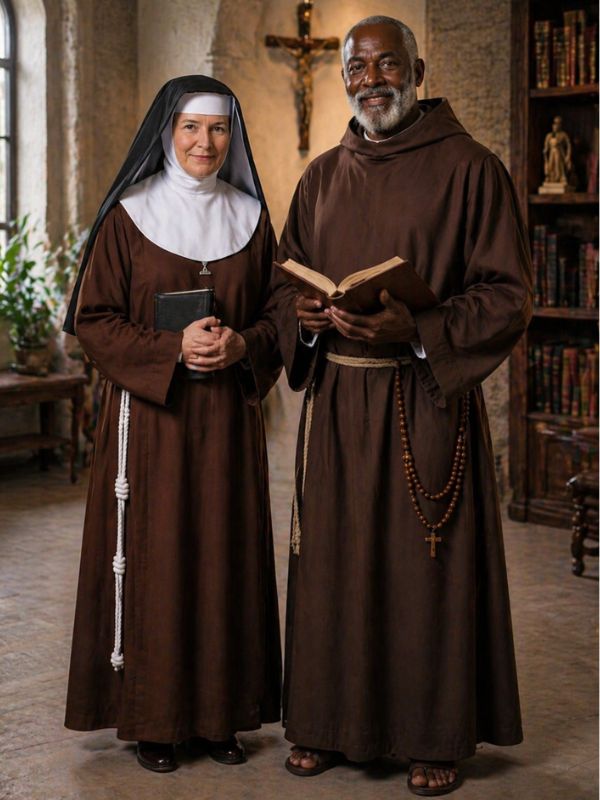
In 1206, a twenty-four-year-old Italian named Francis stood in the main square of Assisi and took off all his clothes. This was not a protest in the modern sense, it was a statement directed at one specific person: his father, Pietro di Bernardone, a cloth merchant who had spent months trying to drag his son back to the family business after Francis started giving away merchandise and money to the poor.
Pietro had hauled Francis before the local bishop to legally disown him. Francis responded by handing back every item of clothing he was wearing. He walked out of that square with nothing. The bishop gave him a rough peasant’s work tunic. Francis wore that style of tunic, more or less, for the remaining twenty years of his life.
That is the origin of the Franciscan habit. Everything about it encodes poverty: undyed brown or grey wool (the cheapest, least processed cloth in medieval Europe), a deep practical hood, no leather belt. The belt is rope, white cord, knotted three times. Each knot stands for one vow: poverty, chastity, obedience. A Franciscan friar carries those three commitments visually, physically, around his waist every day.
What gets missed about Franciscan clothing is its social function. Francis didn’t design a monastery habit, he designed street clothing for people who would live among the poor, not apart from them. When a friar walks into a hospital ward or a homeless shelter in that habit, the message precedes him. He owns nothing. He chose this. That’s not incidental to the mission; it’s the mission, wearing a tunic.
3. Dominican Order
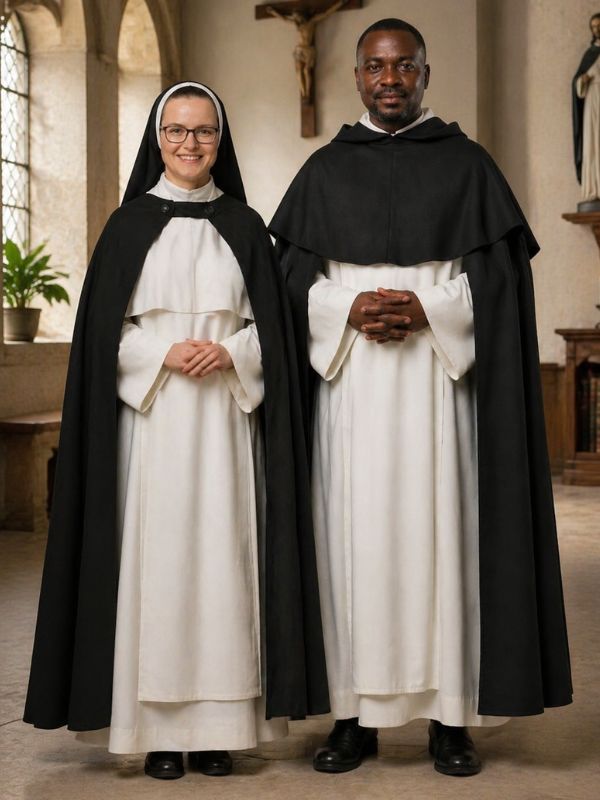
Dominic de Guzman spent several years in southern France in the early 1200s watching a heresy eat through the church. The Cathars , a group who believed the material world was evil and the spiritual world was all that mattered , had attracted enormous followings partly because the local clergy were visibly corrupt and wealthy while preaching austerity. Dominic’s insight was that you couldn’t argue people out of heresy with logic alone if your own life was a walking contradiction of everything you preached.
He founded the Order of Preachers in 1216. The habit he gave them, white tunic and scapular, long black outer mantle was chosen with that history in mind. White for purity of doctrine, the clarity required of someone who teaches. Black for the penitential weight the preacher accepts, the willingness to take on the burden of other people’s spiritual confusion. Together: someone who studies hard, lives simply, and goes out to explain things.
Thomas Aquinas was a Dominican. He entered the order in 1244, against his family’s wishes (his brothers actually kidnapped him to try to stop him), and went on to write the Summa Theologica, one of the most systematic and rigorous works of philosophy ever produced,while wearing that white and black habit. The order that looks the most formal produced the most formal thinker. That’s not a coincidence.
4. Carmelite Order
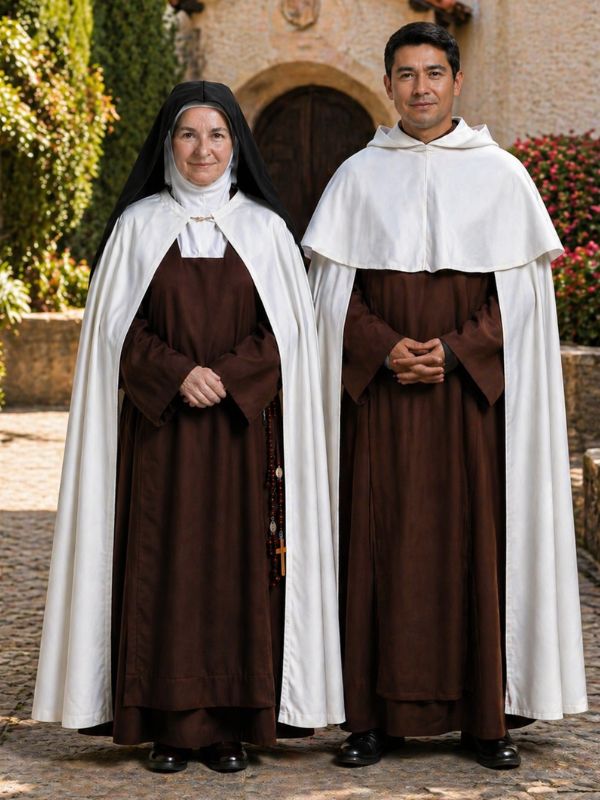
Mount Carmel is a ridge on the northern coast of what is now Israel. In the 12th century, a group of Christian hermits settled in the caves and ravines of that hillside, not because anyone sent them there, not because a founder gathered them, but because the mountain had been associated with the prophet Elijah for centuries and it seemed like a good place to pray. They built a chapel. They adopted a rule. They started wearing brown.
That earthy brown ,warm, rough, the colour of sun-dried hillside, is still what Carmelites wear. A tunic, a long brown scapular (two rectangular panels of cloth front and back, connected at the shoulders), and a white mantle for choir and formal occasions. The scapular became so central to Carmelite identity that a small version of it, two tiny panels of brown wool on a string, became one of the most widespread devotional objects in Catholic history. Millions of lay people wear it under their clothes as a sign of connection to Mary and the Carmelite tradition.
Two people who wore the full Carmelite habit in 16th century Spain went on to write some of the most penetrating accounts of human psychology ever committed to paper: Teresa of Ávila and John of the Cross. Their subject was the interior life, how prayer changes a person from the inside, what it feels like when it works, what it costs when it’s difficult. The brown robe they wore was designed for people who treat silence as a discipline, not an absence.
5. Augustinian Order

Not many people talk about the Augustinians, but they should. This order traces back to Saint Augustine of Hippo, a 4th century bishop whose book Confessions is still read worldwide today. Augustine never started a religious order himself, but his ideas about community life and the inner journey to God were so powerful that later communities built their entire rule around them.
The order was officially formed in 1244 when Pope Innocent IV brought several smaller hermit groups together under one roof.
Their habit is all black, black tunic, black leather belt, black hooded scapular, and a wide black mantle for going out. From a distance they can look similar to Dominicans, which has confused people for centuries.
But the black means something different here. For Augustinians, it points inward. Augustine believed the real journey to God happens inside a person, through honest self-reflection, not outward show. His most famous words say it simply: “our heart is restless, until it repose in Thee.” That quiet searching is what the habit represents.
One member of this order changed history completely. Martin Luther joined the Augustinians in 1505, spent years wrestling with questions Augustine had written about centuries earlier guilt, grace, forgiveness and in 1517 nailed his Ninety-Five Theses to a church door in Wittenberg. He was still wearing the Augustinian habit when he did it. The Protestant Reformation was born inside this order.
6. Jesuit Order
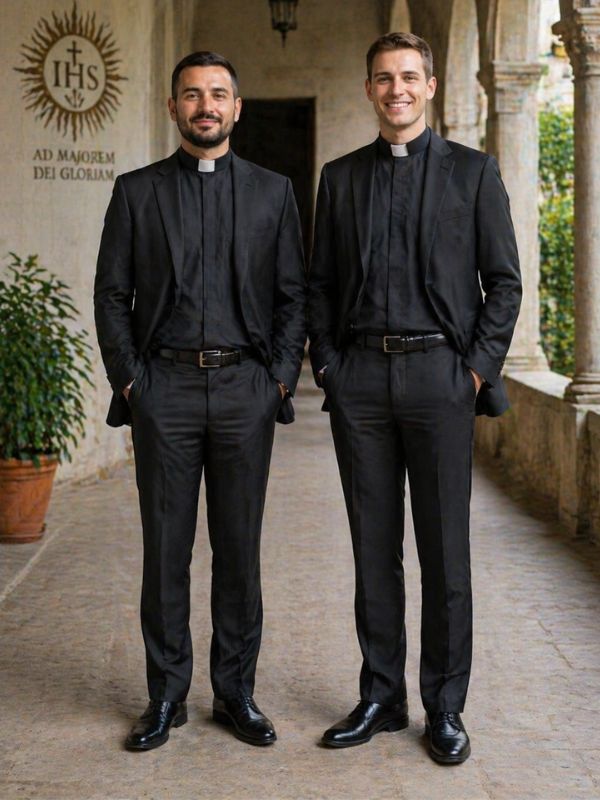
Ignatius of Loyola founded the Society of Jesus in 1540 and made one quiet, radical decision, no habit. Jesuits wear plain black clerical dress. No hood, no distinctive robe, nothing that marks them as different from any ordinary priest on the street.
That was the whole point.
Ignatius built the Jesuits to go everywhere, China, Japan, India, the Americas, the Protestant courts of Europe. A recognisable monastic robe would have closed doors before a single conversation started. In Ming Dynasty China, it would mark you as foreign. In Protestant England, it would mark you as a threat. Plain clothes removed the barrier.
A Jesuit could walk into a university, a palace, or a marketplace and simply be a man in black. No first-impression response to overcome. No habit doing the talking before he could.
Ignatius believed his men should be known by how they thought and how they served, not by what they wore. That single decision freed the order to become what it became: the most widely travelled, most intellectually influential missionary force in early modern Christian history.
The absence of a habit was itself the statement.
7. Missionaries of Charity
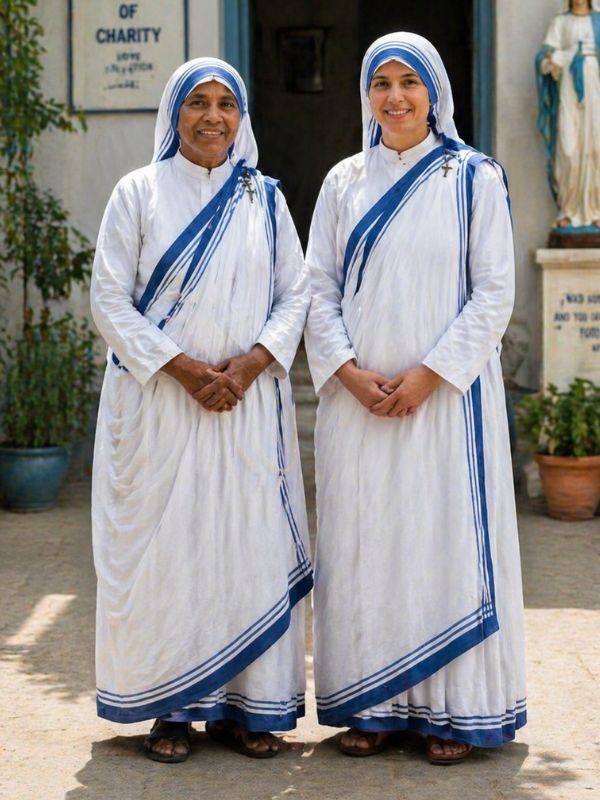
Mother Teresa, born Agnes Gonxha Bojaxhiu in North Macedonia, spent nearly twenty years teaching in Calcutta before she felt called to leave the classroom and serve the poorest people on the streets. She asked for permission in 1946. It took two years. She started with almost nothing.
The congregation she founded in 1950 chose something completely different from traditional religious clothing, a plain white cotton sari with three blue stripes along the border and a small crucifix on the left shoulder.
The choices were simple and deliberate. The sari was ordinary dress for poor Indian women, so wearing it said: we belong here, with these people. White stood for purity. Blue came from Mary. Cotton was cheap, practical, and easy to wash daily, essential for women working in slums and hospices.
By the time Mother Teresa died in 1997, over four thousand sisters were wearing that same simple sari across 123 countries. No elaborate symbolism, no historical layers. Just a garment that said: we show up, we serve, we don’t need to be noticed.
Religious Habits After Vatican II — What Changed, What Came Back
The Second Vatican Council (1962–1965) asked religious communities to revisit their habits, to ask honestly whether the garment still expressed the founding charism, or whether it had simply become a costume worn out of inertia. A lot of women’s congregations took that question seriously and simplified it substantially. Some moved to ordinary dress with a single identifying element. A few abandoned distinctive clothing altogether.
By the 1990s, the trend had started reversing. Younger people entering religious life were increasingly drawn to communities that wore the full traditional habit. The reasons given were remarkably consistent: the habit makes the vocation visible in a culture that rarely encounters it, it creates a sign of different values in public spaces where those values rarely appear; it connects the person wearing it to everyone who wore the same garment before them.
Both streams still run today. You will encounter a Dominican sister in full white and black, and a Dominican sister in a plain skirt suit with a small cross. Neither is making the wrong choice. What they represent is a genuine, unresolved conversation inside religious communities about what witness actually looks like now and whether clothing is part of it or beside the point.
Conclusion:
Every religious habit is making a claim, not just about identity, but about the relationship between what you wear and who you become. The Benedictine puts on black each morning and is reminded of the self left behind at the monastery gate. The Franciscan touches three knots and is returned to the three things that organise everything else. The Augustinian black points inward, toward the restless searching that Augustine described in the fourth century. The Missionaries of Charity’s white cotton sari says: we go where the need is, without ceremony, without requiring the work to be admired.
Modern culture treats clothing as expression, as something you choose to communicate who you already are. The monastic tradition inverts this completely. The habit doesn’t express an existing identity. It works on the person wearing it, day after day, year after year, slowly shaping the person they’re trying to become. That’s a sophisticated and counterintuitive idea about how human formation actually works.
The figure in the robe isn’t dressed for you. But now you know what they’re saying





Recent Comments