
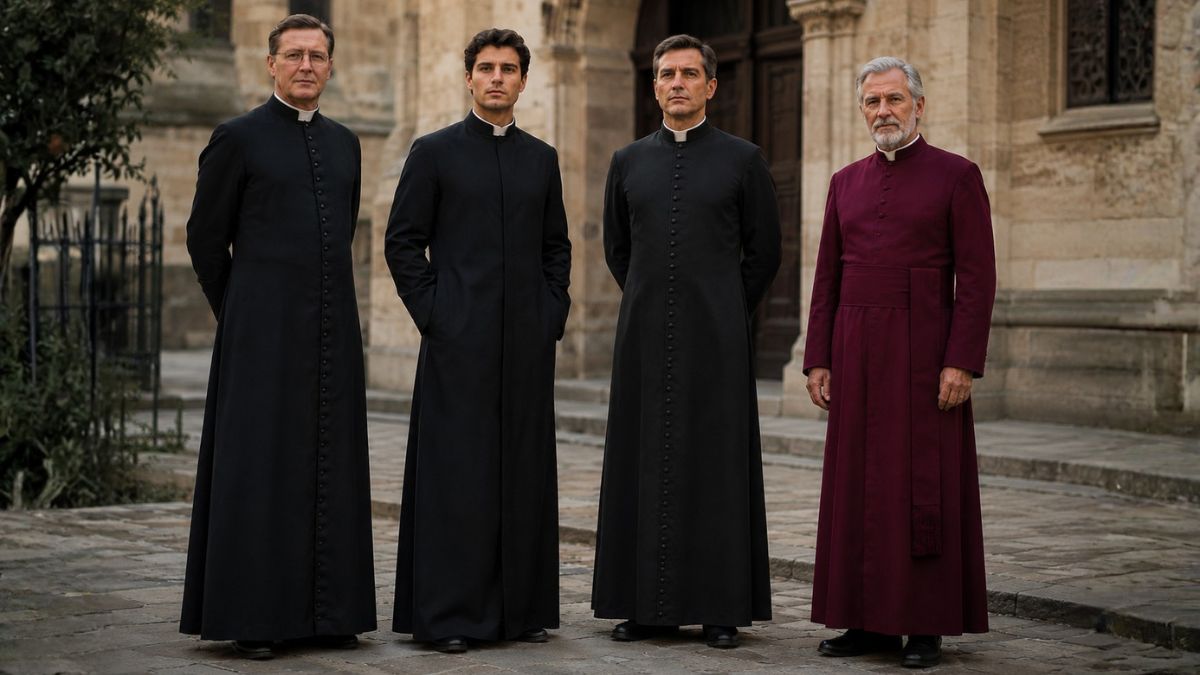
Sit in the front pew of a traditional Catholic parish and watch the priest process before Mass. You’ll notice the long black robe, the collar, maybe a sash around the waist. What most people never notice and almost never think to count is the row of buttons running straight from the collar to the hem.
There are exactly 33 of them.
That number isn’t random. It isn’t a tailor’s preference. It isn’t because 33 buttons happen to distribute evenly across an ankle-length garment. Centuries ago, church leaders designed each button to help priests reflect on the life of Christ while dressing for service.
That’s the cassock. And once you understand what its buttons actually mean, you’ll never look at one the same way again.
The Cassock Definition Most People Get and What’s Missing From It
Pull up any dictionary and you’ll find a cassock definition that reads something like this: a long, close-fitting, ankle-length garment worn by clergy. That’s accurate as far as it goes.
What it doesn’t tell you is that the cassock carries deep symbolic meaning and is one of the most layered garments in Christian tradition. The color matters. The cut matters. The number of pleats in the back matters.
And yes the button count matters, and it matters differently depending on which church tradition the wearer comes from.
Clergy across Catholic, Anglican, Episcopal, Eastern Orthodox, Lutheran, and Presbyterian traditions wear some version of the cassock. It has been part of the mens priest outfit for over a thousand years, longer than most nations have existed. The Fourth Lateran Council in 1215 formally codified what clergy must wear. The cassock’s distinctive design has been maintained deliberately ever since, not out of conservatism for its own sake, but because the symbols built into the garment still carry real theological weight.
The buttons are the most visible of those symbols. Let’s go through each tradition one by one.
33 Buttons: The Roman Catholic Tradition

The traditional Roman Catholic cassock, technically called the soutane , carries 33 buttons running down the front from collar to hem.
Thirty-three. The number of years Jesus Christ lived on earth.
Think about what that means in actual practice. A Catholic priest or seminarian who buttons his cassock every morning runs his hands down 33 individual buttons in sequence. Some do it in silence. Some quietly pray. The act of dressing becomes, if the wearer chooses to receive it that way, a daily meditation on the full span of Christ’s life, from birth in Bethlehem through his public ministry to his death and resurrection.
Pope Sixtus V made the cassock mandatory dress for Catholic clergy in 1589. The button symbolism wasn’t mandated from above; it grew from within the tradition, gradually and organically. Until the 33-button count became the recognized standard for the Roman cassock. Today it remains the most widely recognized version of the garment worldwide.
What Else Is Sewn Into the Cassock
The 33 front buttons are only part of the symbolism built into a fully traditional Roman cassock. Most guides online stop there. They shouldn’t.
The cuff buttons. A properly made Roman cassock includes 5 buttons on each sleeve cuff. Those represent the Five Wounds of Christ, both hands, both feet, and the wound in his side at the crucifixion. Hold both hands together in prayer, and you have 10 cuff buttons combined. That’s the Ten Commandments.
The cuffs themselves. The cuffs are traditionally cut to 7 inches, a reference to the seven days of creation. Completeness. The fullness of God’s creative work.
The back pleats. Most Roman cassocks have 3 pleats sewn into the back fabric, representing the Holy Trinity: Father, Son, and Holy Spirit. Some cassocks carry 5 pleats instead, again referring to the Five Wounds. St. Stephen’s House in Oxford, one of the prominent Anglican theological colleges, requires ordinands to wear a five-pleat cassock for exactly this reason.
The color black. The standard black of the Catholic cassock has been interpreted in two ways that aren’t contradictory. It represents humility and the death of worldly ambition, the priest sets aside his own story to step into Christ’s. It also carries the symbolism of mourning and sacrifice. The priest wears black because his life has been given over.
All of this built into a garment that most people see for 90 minutes on Sunday morning and never consciously examine.
39 Buttons: The Anglican Tradition

Cross into the Anglican world, and the button count shifts to 39.
The reason is entirely doctrinal.
The traditional single-breasted Anglican cassock carries 39 buttons to represent the Thirty-Nine Articles of Religion , the foundational doctrinal statements of the Church of England, finalized in 1571. These articles defined Anglican theology at a moment of profound historical pressure, when the English church was formally establishing its identity distinct from Rome. They remain, to this day, a core reference point for Anglican belief.
An Anglican minister buttoning his cassock is, in one reading, running through the doctrinal heritage of his church. One person who attended an Anglican parish described watching their minister do exactly that quietly reciting each article while dressing before a service. The cassock functions as a living catechism, teaching faith through what it represents.
There is a second interpretation some Anglican clergy hold alongside the first. The 39 buttons also refer to “Forty Stripes Save One” from 2 Corinthians 11:24, where Paul writes that he received 39 lashes from Jewish authorities five separate times during his ministry. That’s 195 lashes total for preaching the Gospel. In that reading, each button is a mark of endurance, a reminder of what the ministry has historically cost.
Neither interpretation cancels the other. Anglican theology has always been comfortable holding two things at once.
The Two Cuts of the Anglican Cassock
Anglican clergy use two different cassock designs, and the choice between them carries its own message.
The single-breasted cassock (sometimes called the Roman-style) has buttons running straight down the center front. It’s most common among Anglo-Catholic clergy, those who lean toward a more traditional, high-church theology and practice that maintains close continuity with Catholic liturgical tradition.
The double-breasted (Sarum) cassock fastens at the shoulders and waist rather than down a full-length center front. It’s associated with the evangelical wing of Anglicanism, and its visual difference from the Roman Catholic style is, in some sense, deliberate. It looks different because it represents something different.
Anglican bishops wear purple cassocks. Archdeacons and cathedral deans typically wear black cassocks with red piping or buttons. Scarlet cassocks are reserved for a narrow group: royal chaplains and clergy at royal foundations like Westminster Abbey and certain Cambridge college chapels.
The Jesuit Cassock: No Buttons at All

The Society of Jesus, the Jesuits chose a different path entirely.
The Jesuit cassock has no front buttons. The fly front fastens with hooks at the collar, and the cassock is tied at the waist with a black cincture, knotted on the right side.
This is not an accident or a simplification. It is a design choice that reflects who the Jesuits are.
Founded by Ignatius of Loyola in 1540, the Society of Jesus was built around mobility, intellectual engagement, and mission work in the world ,not enclosed monastic life. Jesuits went to Japan, to India, to the Americas, to the courts of European monarchs.
A cassock that requires carefully buttoning 33 symbols doesn’t suit that kind of movement. The hookless, buttonless design reflects an order that needs to be ready to act.
The absence of buttons is itself a theological position: the Jesuit moves through the world, not around it.
The Ambrosian Cassock: Five Buttons

The Ambrosian Rite, associated with the Diocese of Milan and the legacy of Saint Ambrose, produces a third button count entirely.
These cassocks have just 5 buttons at the neck, with a sash at the waist holding the garment closed. Again, five: the Five Wounds of Christ. The design is dramatically more minimal than either the Roman or Anglican version, restrained in a way that reflects the particular theological temperament of the Milanese tradition.
Most people outside Northern Italy have never encountered this style. It exists, though, and it illustrates something important: the button symbolism in cassock design isn’t one universal language. Each tradition developed its own vocabulary, and each vocabulary points to what that tradition values most.
How the Color of the Buttons Tells You a Priest’s Rank
In the Roman Catholic Church, beyond the count itself, the color of the buttons and trim functions as a visible rank indicator. Walk into any formal Catholic context and a trained eye can read the entire clerical hierarchy from button color alone.
- Black buttons on a black cassock — ordinary parish priest, deacon, or major seminarian. The baseline of Catholic clergy dress.
- Purple buttons and trim — a Chaplain of His Holiness, an honorary title granted by the Pope to clergy who have rendered notable service to the Church.
- Amaranth red buttons and trim — bishops, archbishops, honorary prelates, and protonotaries apostolic. Amaranth is a deep pinkish-red, distinctly different from cardinal red.
- Scarlet red buttons and trim — cardinals. In full choir dress, a cardinal’s cassock becomes entirely scarlet rather than just trimmed with it.
- All white — the Pope alone. White cassock, white sash, sometimes embroidered with his coat of arms.
No introductions needed. No nametags. A parish priest meeting a bishop for the first time knows within seconds who he is standing with.
Do Modern Cassocks Still Follow These Button Counts?
Budget cassocks sold online at low price points often use mock buttons , buttons sewn onto a fly front that fastens with a hidden zipper or snaps. The visible count might be 18, 24, or some other number chosen by the manufacturer for how it looks, not what it means. The symbolism is absent, even if the silhouette is similar.
A properly made, traditionally constructed cassock from a specialist ecclesiastical tailor , whether in England, Italy, the United States, or elsewhere follows the correct count. When a priest orders a “33-button Roman cassock,” that’s 33 individually placed buttons, each one functional or correctly positioned according to the standard. The same applies to a 39-button Anglican cassock: the count is deliberate and correct.
This is worth knowing before you buy. A cassock that will be worn for ordinations, funerals, installations, and regular liturgical service is worth doing right. The symbolism is part of the garment’s function , not decorative, not optional.
What Protestant Pastors Actually Wear and How the Cassock Fits In
Not every Christian tradition uses the cassock as part of the standard mens priest outfit. Many Protestant denominations, Baptist, Methodist, non-denominational, COGIC, and Pentecostal churches among them, typically dress clergy in pulpit robes, Geneva gowns, or preaching robes. These garments may have buttons, but the number isn’t assigned the same fixed theological meaning as in the Catholic or Anglican traditions.
That is changing, gradually.
More Protestant clergy are choosing the cassock for formal services today than at any point in the last 60 years. When they make that choice, they almost always reach for the 33-button Roman style, even if they don’t come from a tradition that historically used it. The Catholic symbolism has become, by wide recognition, the most universally understood version of cassock theology. Wearing those 33 buttons signals something regardless of denomination: this is a person who takes the tradition of Christian ministry seriously.
Frequently Asked Questions
Q: What is the cassock definition in plain terms?
A cassock is a long, close-fitting, ankle-length robe worn by ordained clergy across Catholic, Anglican, Orthodox, Lutheran, and some Protestant traditions. It is typically black, though colors vary by rank and denomination. It serves as both everyday clerical dress and as the foundational layer worn beneath formal vestments during worship.
Q: Why does a Catholic cassock have 33 buttons?
The 33 buttons on a Roman Catholic cassock represent the 33 years of Jesus Christ’s earthly life , from birth to baptism to ministry to crucifixion and resurrection. Each morning when a priest buttons his cassock, he moves through those 33 years before beginning his day of ministry. It is one of the most quietly significant acts of devotion built into the mens priest outfit.
Q: Why do Anglican cassocks have 39 buttons instead of 33?
Anglican cassocks traditionally carry 39 buttons representing the Thirty-Nine Articles of Religion, the foundational theological statements of the Church of England drafted in 1571. Some clergy also interpret the 39 as a reference to “Forty Stripes Save One” (2 Corinthians 11:24), symbolizing suffering endured in ministry. The difference from the Catholic 33 is deliberate theological distinction, not coincidence.
Q: What is the correct mens priest outfit for a Catholic priest?
For most Catholic priests, the standard daily dress is the black cassock (33-button Roman style) or a black clerical suit with a Roman collar. During Mass, the cassock is worn underneath an alb, stole, and chasuble. The specific combination varies by occasion, rank, and diocesan custom. The cassock remains the formal standard; the clerical suit is the practical daily alternative.
Q: What should a pastor wear for weddings and funerals?
For Catholic and Anglican clergy, a cassock with appropriate vestments (alb and stole for weddings without Mass; full Mass vestments if applicable) is standard. For Protestant pastors, most wear a dark suit or preaching robe depending on denomination. The general principle across traditions is that the occasion calls for formality and the garment should reflect the solemnity of the event, not personal convenience.
Q: Can a layperson or choir member wear a cassock?
Yes. In Catholic and Anglican traditions, altar servers, acolytes, and choir members regularly wear cassocks , often a black cassock paired with a white surplice over it. These cassocks typically follow a simplified version of the standard design and may not carry the same precise button count as an ordained priest’s cassock. The practice varies by parish and choir director.
Q: What is clergy attire for men across different denominations?
This varies considerably. Catholic and Orthodox clergy wear the cassock or cassock-alb. Anglican clergy wear the cassock with surplice and tippet. Lutheran and Methodist clergy often wear an alb with a colored stole. Baptist and non-denominational pastors typically choose a suit, clergy collar shirt, or preaching robe. COGIC bishops wear distinctive vestments specific to their tradition. The common thread is that clergy attire for men is meant to signal the office, not the individual. The garment points away from the wearer, not toward him.
The Point That’s Easy to Miss
Most writing about cassock buttons focuses on the number 33, 39, 5 and leaves it there. That’s useful as far as it goes.
What’s harder to communicate is what those numbers actually do for the person wearing the cassock.
An older priest wrote in a National Catholic Register article that the cassock “hides a multitude of imperfections.” He meant it practically — the garment is forgiving of what’s underneath. But the phrase works theologically too. When a priest puts on the cassock, something changes. He stops being just himself. He becomes legible as a representative of something much older than his own biography.
The buttons are part of that transformation. They’re not decoration. They’re not tradition for tradition’s sake. Each number is an anchor , 33 to the life of Christ, 39 to the doctrine of a church, 5 to the wounds of the cross. Every morning, putting on the cassock becomes a reminder of the priest’s purpose and calling in service.
That’s not a small thing. And it’s worth knowing.
Holy Clergy carries traditionally made cassocks with accurate button counts, including the 33-button Roman cassock, Anglican-style options, and the full range of mens priest outfit essentials for Catholic, Anglican, Baptist, Methodist, and non-denominational clergy. Standard and custom sizing available. Browse the collection at clergy cassocks for men.




Recent Comments